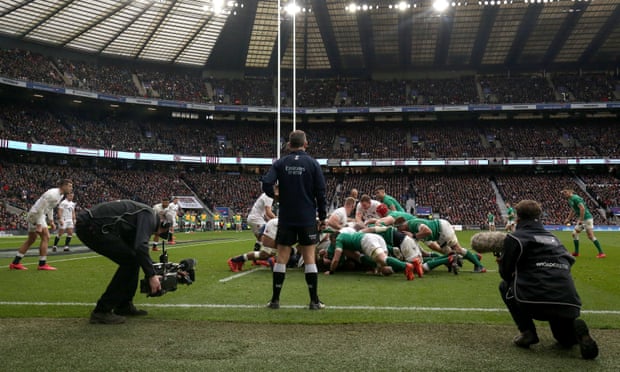
Sometimes we overlook the fragility of the thread connecting rugby with the public. It is not a sport that necessarily appeals to everyone, even if they do have a vague grasp of the laws. For some it is too brutal and painful to watch in comfort; if you have never played there are plenty of reasons to doubt the sanity of those who do. You don’t get cauliflower ears playing badminton.
It is also a sport heavily reliant on its heritage and history. England against Wales on Saturday would be just another game without its evocative past, its cross-border element and its “them and us” cultural undercurrents. Much like the Grand National, people of all backgrounds will watch the Six Nations even if they don’t much care for the actual sport.
The outcome also clearly matters, as much now as it ever did. Sit anyone down in front of the anthems and they will instantly notice the depth of passion involved. A strong case could be made that listening to the soaring roar of Hen Wlad Fy Nhadau at the Principality Stadium is one of life’s greatest experiences, regardless of your nationality. For any child watching at home, it offers a tantalising window to another world, where it is neither a crime to throw your weight around nor uncool to show you care.
Always assuming, that is, you can see it. I can still vividly remember, aged eight, peeling away from the jelly and vanilla ice cream at my brother’s sixth birthday party in our local village hall to nip home with Dad and watch a potentially decent televised game in late January 1973. Maybe it was fate but watching Phil Bennett weave his magic in his 22 and Gareth Edwards diving spectacularly over in the corner for the Barbarians against the All Blacks changed my life. I was hooked immediately and have been ever since.
Quick guide
Free-to-air motion tabled in parliament
Show
Advertisement
Which begs the question: what if that match hadn’t been on free-to-air television? It might have permitted second helpings of jelly, true, but a lack of exposure to rugby on terrestrial TV would, in my case, have made a fundamental difference. We lived in a rural area with not a single rugby club nearby. No one in the family played rugby; even now my mum still refers to it as “that awful game”. Depending on the school you went to it would have been quite possible to miss out on rugby completely.
Times, clearly, have changed, as have viewing habits. It could be that today’s eight-year-olds, with so many alternative online avenues to explore, would not have their eyes opened in the same evangelical way by Owen Farrell and Ben Youngs or Gareth Davies and Jarrod Evans. That said the suggestion that the Six Nations, egged on by private equity investors CVC, is looking to duck behind a paywall in exchange for at least £300m still feels like a massive punt. Cut the umbilical cord between the Six Nations and its fair-weather audience and the knock-on effect will be enormous. The second rugby becomes distant televisual wallpaper – on Sky or Amazon or wherever – it risks losing a significant chunk of its charm.
Chris Ashton on the move again with departure from Sale
Read more
There is also the risk of taking live audiences for granted. Some cannot see the problem with England playing Argentina at 8pm on a Saturday night this November, as the Rugby Football Union has confirmed will be the case. It may, the theory goes, attract more viewers in South America and dovetail better with the other autumn Test kick-offs.
Fine but if the RFU really wants to scare itself it should go and consult the thousands of people who have already stopped going to Twickenham on grounds of price and logistics when the games kick-off at 2.30pm. An 8pm kick-off effectively makes it impossible for anyone on public transport and resident outside the home counties, even before you factor in the pleasures of dark, cold nights and a cramped seat up in the gods. Half of the appeal is the sense of morning anticipation, the colour and enthusiasm of the visiting fans, the tense pre-anthem waiting game. Much of that innocent enjoyment dissolves if you have to leave 20 minutes before the end to catch the last train back to Tiverton Parkway.
Exactly 40 years ago, as it happens, I witnessed my first England against Wales game at the old splintery, wooden-standed, sepia-tinted Twickenham. I stood on my own with someone else’s kindly donated ticket, a shy 15-year-old wedged in tight on the north terrace, and can still smell the mix of beer, tobacco, sweat and ill-feeling hanging in the air. There was increasing political antipathy off the field and a fractious game duly ensued. It was the day the Wales flanker Paul Ringer was sent off for a late elbow on the Englands fly-half John Horton; to say the visiting fans were in sour mood afterwards, having watched their team lose 9-8 to three Dusty Hare penalties, would be an understatement.
At least, though, we could all recycle the famous old Max Boyce line: “I was there.” Live sport, in the end, is less about what you see than how it makes you feel. If access to international rugby at Twickenham were, to become the preserve only of well-off types from the south-east or those able to afford a satellite or digital subscription, massive chunks of the population will be disenfranchised. Rugby needs to think very carefully about the wider implications before it sells its soul.
Going viral
Sign up to the Breakdown for the latest rugby union news
Read more
It would be a shame if the coronavirus situation ends up overshadowing the entire Six Nations title race. The weather has not exactly helped but at least there have been some glimmers of French inspiration to savour. Romain Ntamack and Antoine Dupont must be leading the charge to be named the player of the tournament, albeit with Maro Itoje in hot pursuit, and it can only be hoped France’s remaining games take place. It may also help persuade one or two other coaches to allow their half‑backs more licence to listen to their instincts rather than requiring them to stick to the same old orthodox script.
One to watch
Good luck to the former Newcastle, Toulon and England centre Tom May who is running a marathon a day for six days around the 150-mile London Loop (which stretches around the capital inside the M25) to raise funds for the Teenage Cancer Trust and the My Name’5 Doddie Foundation. He is due to finish his odyssey at Twickenham on Saturday before England’s game against Wales. Donations can be made here.
As 2020 begins…
… we’re asking readers, like you, to make a new year contribution in support of the Guardian’s open, independent journalism. This has been a turbulent decade across the world – protest, populism, mass migration and the escalating climate crisis. The Guardian has been in every corner of the globe, reporting with tenacity, rigour and authority on the most critical events of our lifetimes. At a time when factual information is both scarcer and more essential than ever, we believe that each of us deserves access to accurate reporting with integrity at its heart.
You’ve read more than 5 articles in the last four months. More people than ever before are reading and supporting our journalism, in more than 180 countries around the world. And this is only possible because we made a different choice: to keep our reporting open for all, regardless of where they live or what they can afford to pay.
We have upheld our editorial independence in the face of the disintegration of traditional media – with social platforms giving rise to misinformation, the seemingly unstoppable rise of big tech and independent voices being squashed by commercial ownership. The Guardian’s independence means we can set our own agenda and voice our own opinions. Our journalism is free from commercial and political bias – never influenced by billionaire owners or shareholders. This makes us different. It means we can challenge the powerful without fear and give a voice to those less heard.
None of this would have been attainable without our readers’ generosity – your financial support has meant we can keep investigating, disentangling and interrogating. It has protected our independence, which has never been so critical. We are so grateful.
As we enter a new decade, we need your support so we can keep delivering quality journalism that’s open and independent. And that is here for the long term. Every reader contribution, however big or small, is so valuable.
0 Comments
Enregistrer un commentaire